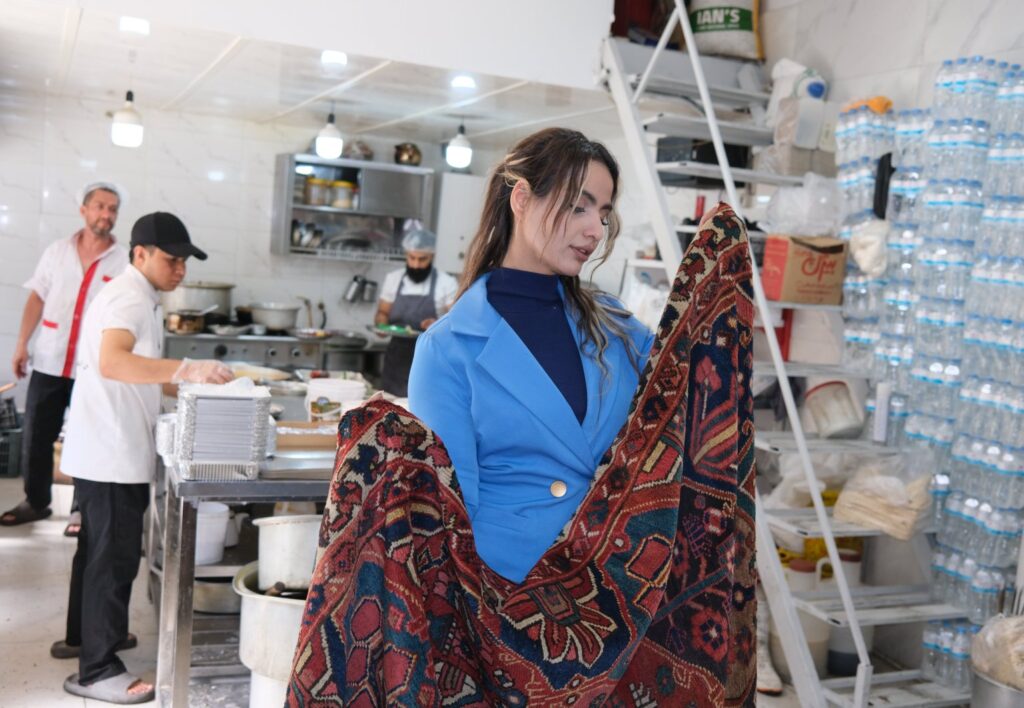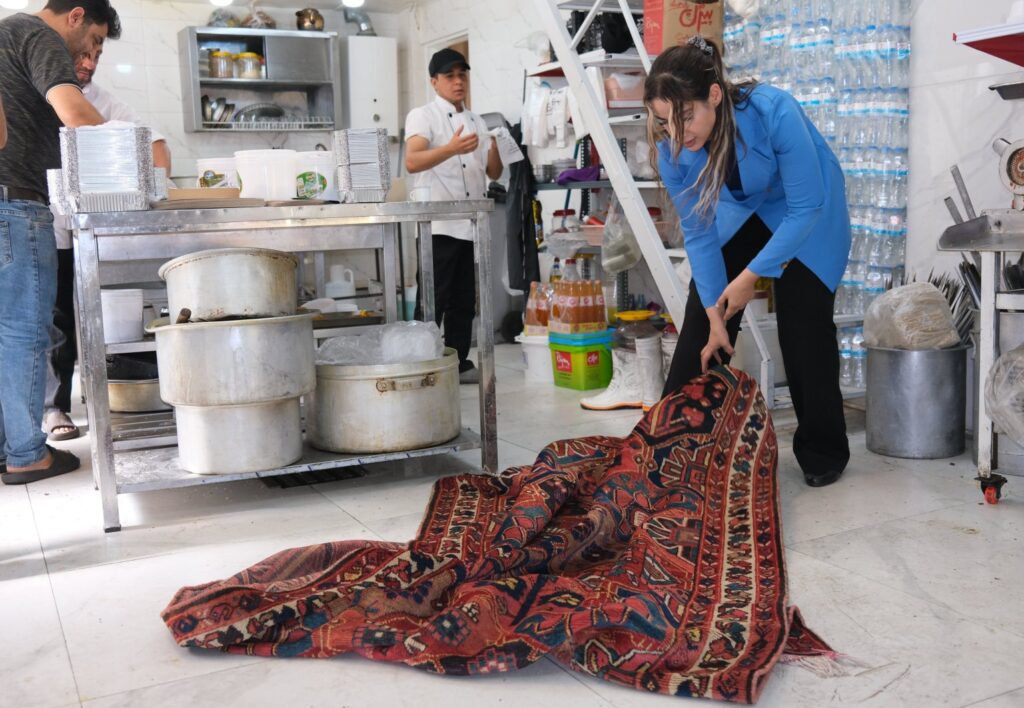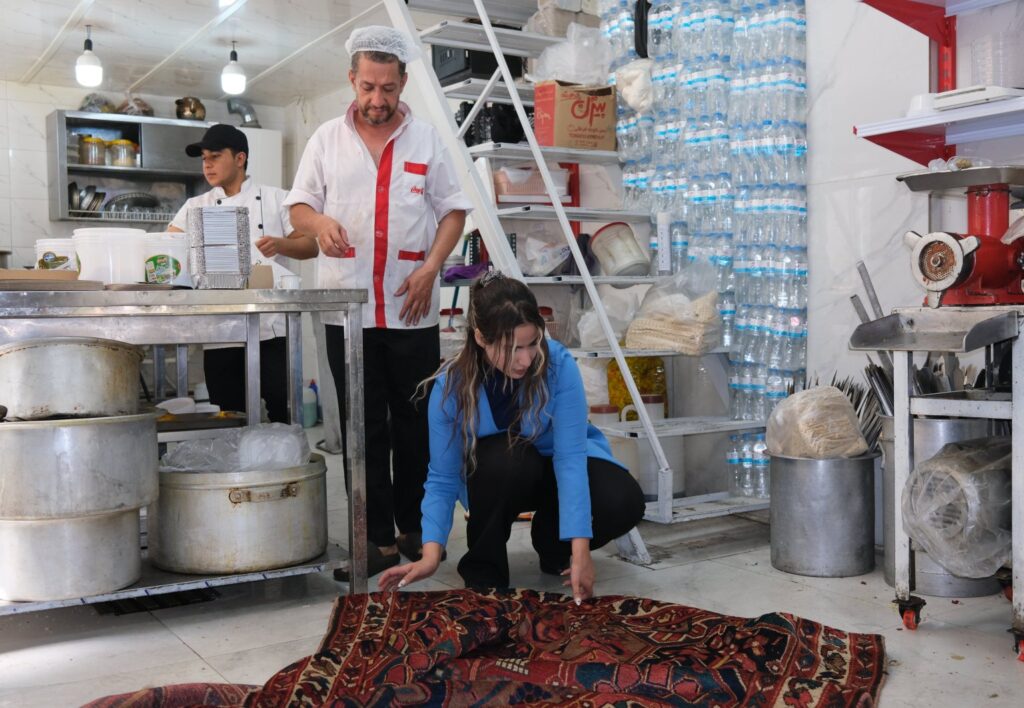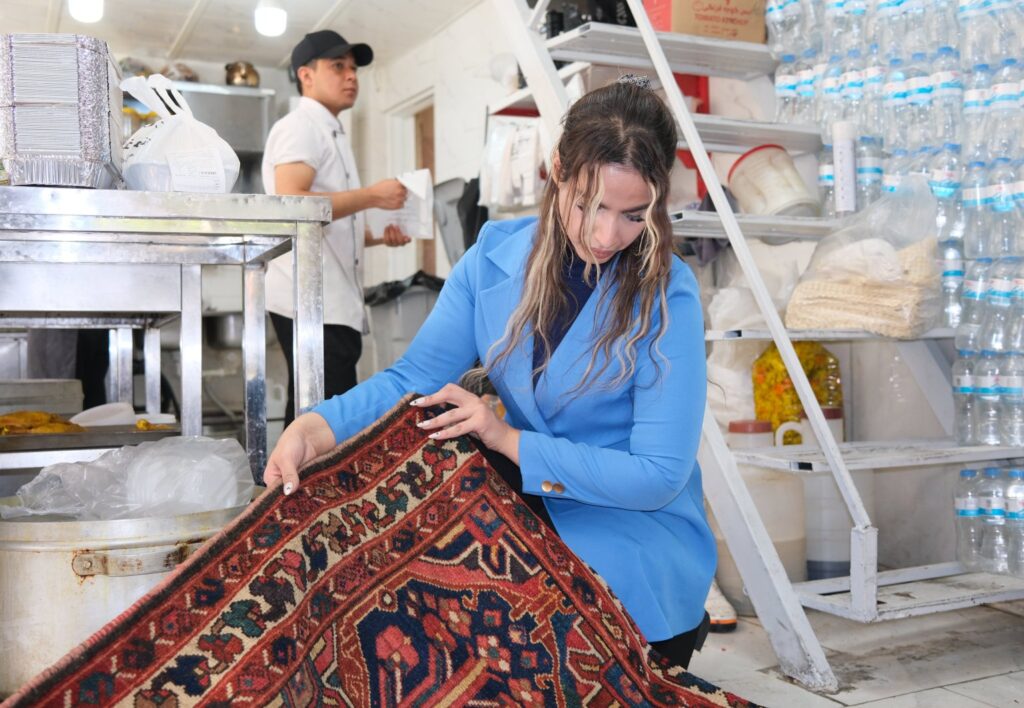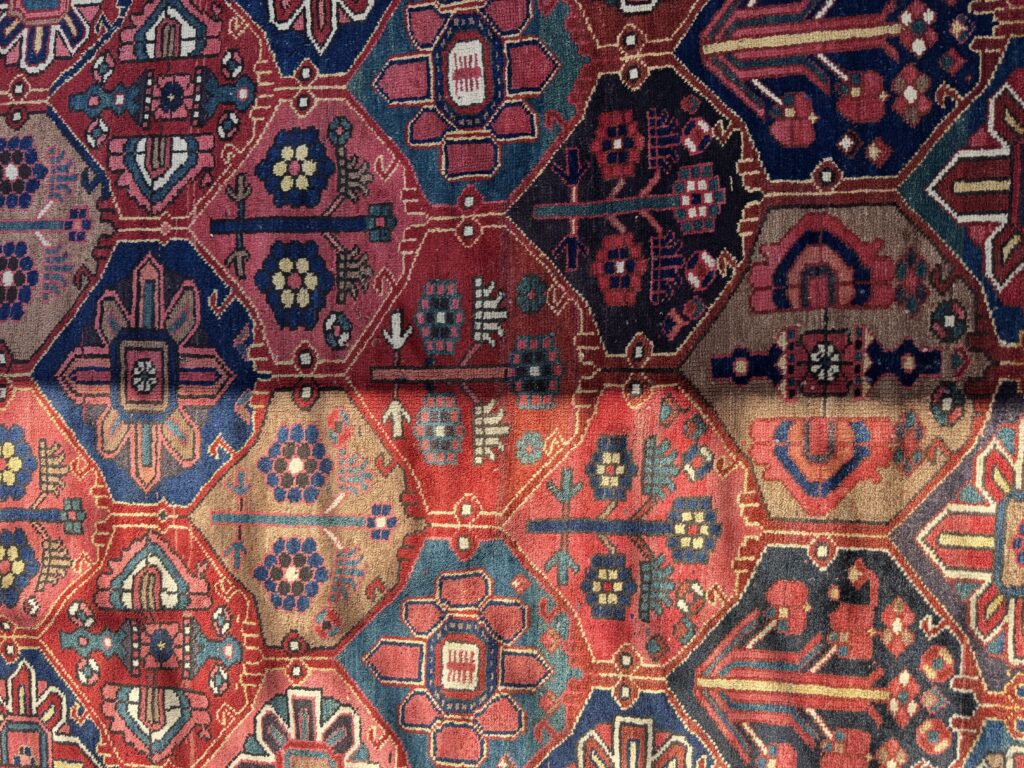
This is a hand-knotted Bakhtiyar (also spelled Bakhtiari) rug from the Chahar Mahal region of western Iran, measuring approximately 240 by 145 centimeters, or roughly 7 feet 10 inches by 4 feet 9 inches. At 75 years old, dating to the late 1940s or early 1950s, this rug sits at the transition between antique and vintage, offering a robust, heavy wool pile that is characteristic of Bakhtiyar weaving. The rug is laid out on a concrete surface under natural sunlight, which highlights the rich, saturated colors and the slight abrash (color variation) across the field.
The color palette of this Bakhtiyar rug is vibrant, earthy, and highly saturated, reflecting the mountainous environment of the Bakhtiyar tribe. The primary field color is a deep, warm madder red, which serves as the background for the large geometric medallions. These medallions are woven in a striking contrast of deep indigo blue, camel or golden brown, and a dusty teal or slate green. The borders feature an ivory or cream ground that provides a crisp, clean frame around the rich red interior. Accent colors include mustard yellow, dark navy blue, and touches of magenta or soft pink. The dyes are entirely natural, with the madder red and indigo blue being particularly stable and vibrant, showing no fading despite the rug’s age.
.This rug features a large-scale, repeating “compartment” or “garden” design, which is the most famous and recognizable pattern of the Bakhtiyar tribe. The field is divided into a grid of large, interlocking geometric medallions. These medallions are diamond-shaped or hexagonal, fitting together like tiles in a mosaic. Within each compartment, there is a separate, self-contained floral or geometric motif, creating the illusion of a walled garden or a pattern of cultivated fields. The rug is oriented vertically, and the compartments are arranged in rows that flow from top to bottom. The entire field is framed by a wide main border, which is flanked by narrow inner and outer guard borders.

The most prominent motifs in the field are the large, compartmentalized medallions. Each compartment is outlined by a thick, stepped border in red or dark blue. Inside each compartment, the central motif varies. Some compartments feature a large, stylized eight-pointed flower or rosette, resembling a lotus blossom or a sunburst, woven in blue, camel, or teal. Other compartments feature a “tree of life” motif, consisting of a central vertical stem with branches, leaves, and small flowers radiating outward. This alternating pattern of flower and tree within the compartments is intentional, creating a sense of rhythm and variety across the rug. The compartments in the bottom row appear slightly larger or differently structured, as they are cut off by the border, a common feature in tribal weaving where the weaver adjusts the pattern to fit the loom.
The main border of the Bakhtiyar rug is a wide band featuring a repeating “flower and leaf” or “vine and blossom” pattern. This border is woven on an ivory ground, which makes the red, blue, and green floral motifs stand out clearly. The motifs in the border are more organic and flowing than the rigid, geometric medallions in the field, showing a subtle Persian influence. The inner and outer guard borders consist of small, repeating geometric shapes, such as stepped diamonds, stars, and zigzag lines. These guard borders act as a protective frame, separating the busy field from the main border and containing the energy of the rug. The outermost edge of the rug features a thin, dark band that secures the fringes.