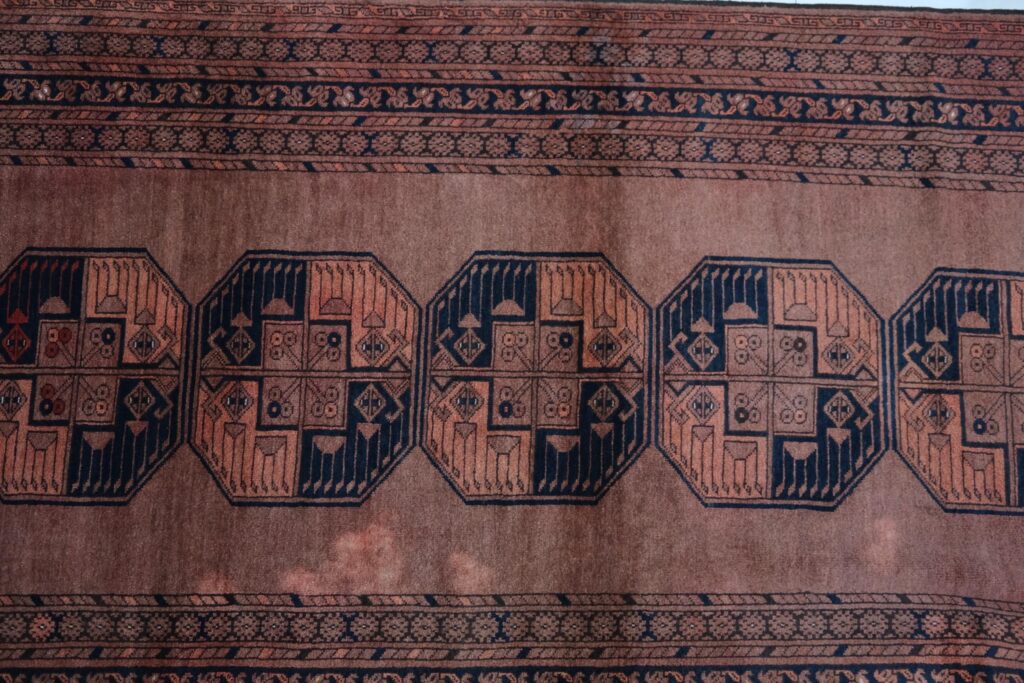
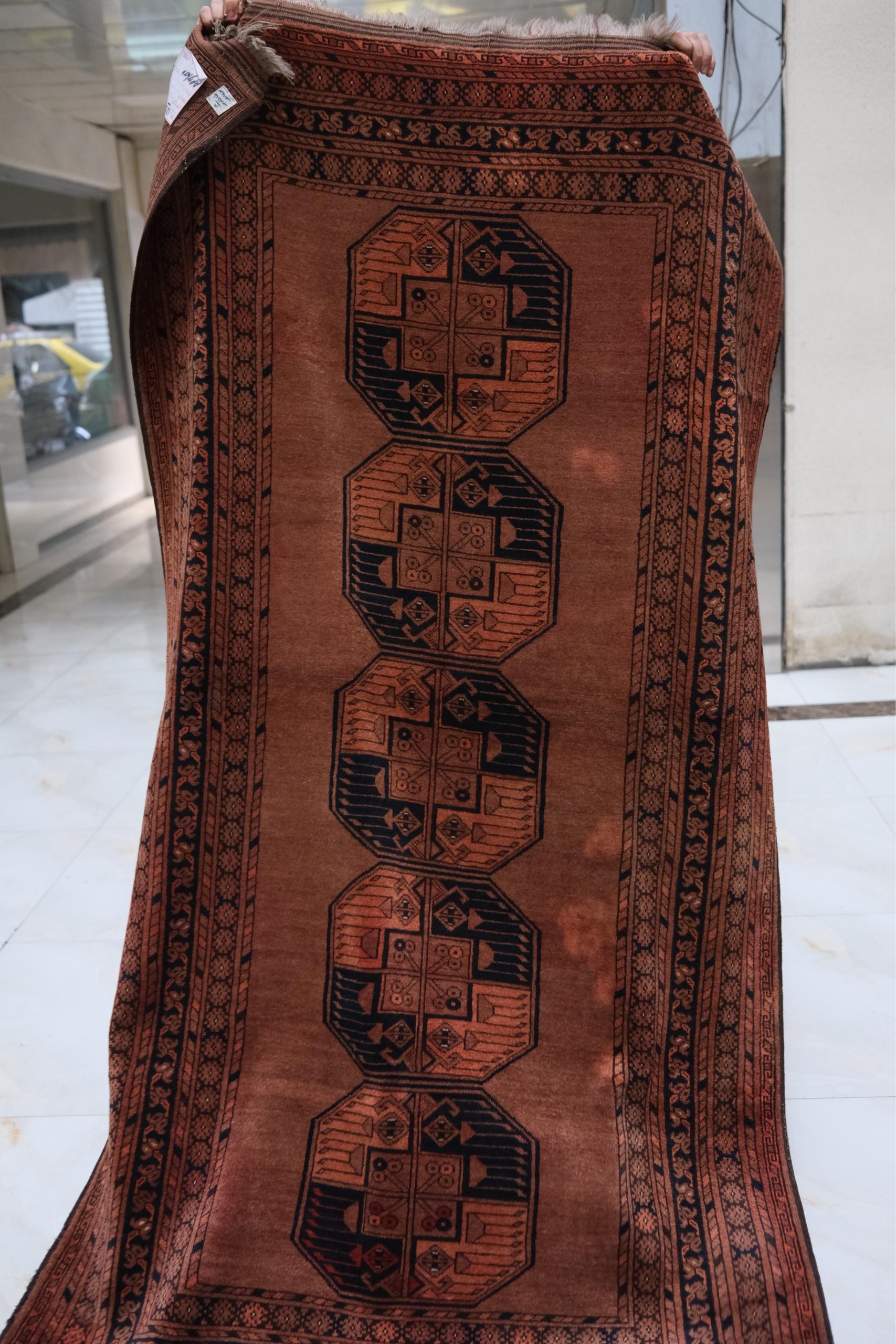
This is a hand-knotted antique Afghan rug, originating from the northern provinces of Afghanistan, likely woven by Turkmen or Ersaritribal weavers. At approximately 120 years old, dating to the late 19th or early 20th century, this piece is a true antique from the golden age of Central Asian tribal weaving. Measuring 230 by 125 centimeters (roughly 7 feet 7 inches by 4 feet 1 inch), it is a long runner or narrow gallery rug, ideally suited for a hallway, a long living space, alongside a bed, or as a striking wall tapestry. Woven entirely from dense, hand-spun sheep’s wool using natural organic dyes, it possesses a heavy, durable pile and a deeply mellowed patina that only a century of natural aging can produce.
The design layout of this Afghan rug is a classic “All-Over Repeating” pattern, featuring a staggered, vertical arrangement of large octagonal medallions known as “Guls” (tribal seals).
The Grid: The field is divided into a precise, repeating grid of octagons, arranged in rows that extend from the top to the bottom. There is no single central medallion; instead, the pattern repeats uniformly, emphasizing the disciplined geometry of the weaver.
Connectors: The spaces between the large Guls are not empty; they are filled with smaller diamond-shaped geometric connectors and stylized hook motifs, which link the medallions together into a seamless, honeycomb-like lattice.
Borders: The rug is framed by a complex, multi-tiered border system. A wide, dark main border surrounds the field, flanked by narrower inner and outer guard borders featuring repeating chevron, diamond, and star motifs that act as a protective architectural frame.
Motifs and Pattern Elements
The motifs in this Afghan rug are strictly geometric, with a heavy emphasis on stepped edges, latch-hooks, and angular, primitive forms.
The Octagonal Gul: The dominant motif is the large, octagonal medallion (Gul). Each octagon features a stepped, serrated outer edge, giving it a jagged, fortress-like silhouette.
The Cruciform Core: Inside each octagonal Gul, there is a cruciform (cross-shaped) interior that divides the medallion into four quadrants. Each quadrant contains intricate, small-scale geometric symbols, including small stars, stepped diamonds, and ladder-like comb shapes.
The S-Hook Border: The main border features a repeating “S-hook” (Running Dog) or “leaf and vine” pattern, where stylized, angular hooks and leaves are connected by a meandering, stepped vine in camel, red, and ivory against a dark navy ground.
The Chevron Guard Borders: The inner and outer guard borders feature sharp, repeating “zigzag” or “chevron” patterns, representing flowing water and life.
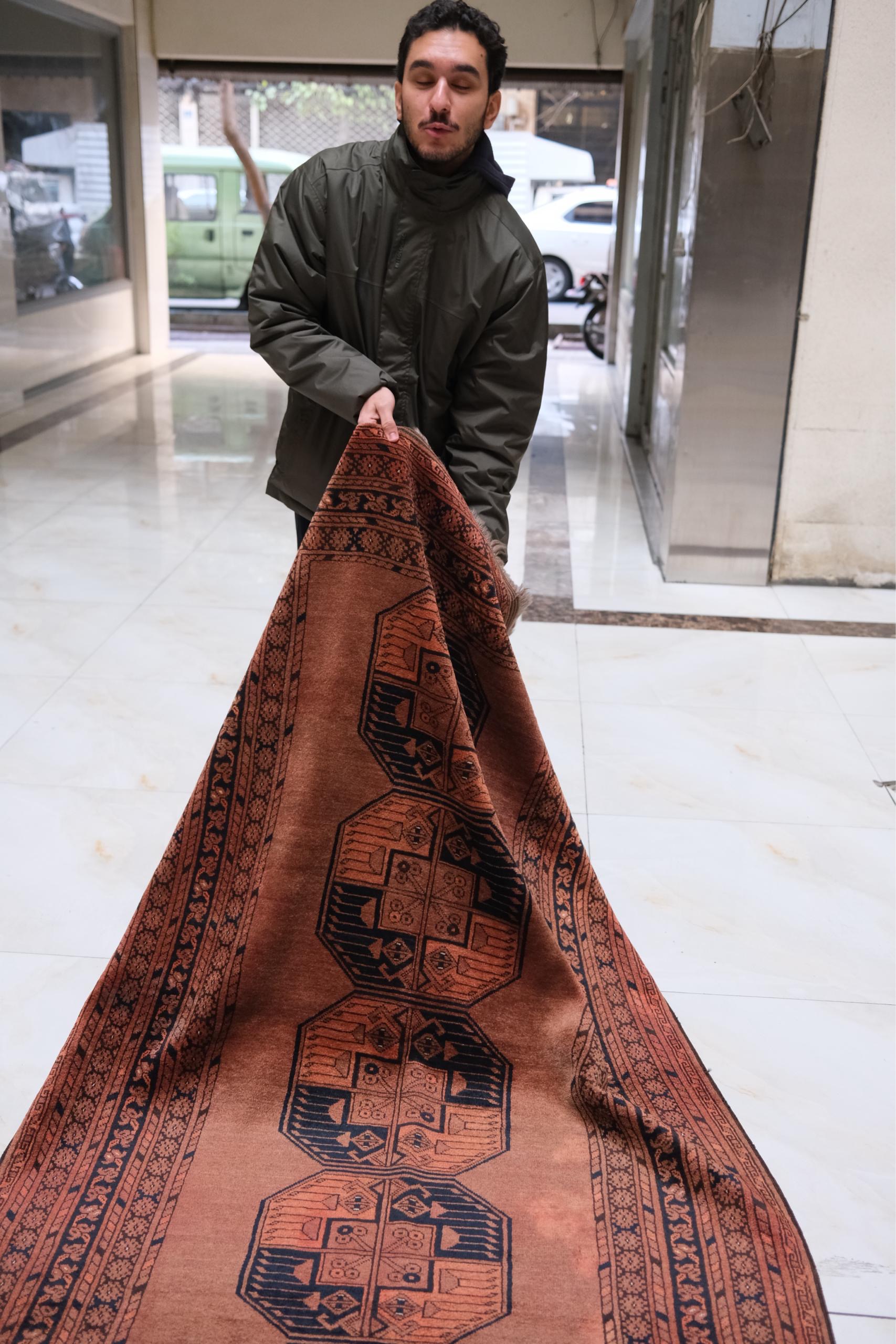
Age: 120 years old (circa late 19th/early 20th century), a true antique.
Size: 230 x 125 cm (7’7″ x 4’1″), a long runner/gallery rug.
Material: 100% dense, hand-spun sheep’s wool with natural organic dyes.
Colors: Warm camel tan/golden ochre field, deep indigo blue and charcoal black Guls, ivory, brick red, and mustard yellow accents; dark navy blue main border.
Design: Classic “All-Over Repeating” tribal layout with staggered octagonal Guls.
Pattern: Stepped, serrated octagonal medallions with cruciform (cross) cores and ladder/comb motifs; main border with repeating S-hook (Running Dog) pattern; chevron guard borders.
Symbolism: Tribal identity/sacred protection (octagonal Gul), four winds/cosmic balance (cruciform core), craftsmanship (weaver’s comb), protective teeth (latch-hooks), steppe/freedom (camel field), night sky/protection (dark border).
Condition: Excellent antique condition for its age; dense, even pile; natural abrash; secure edges.
Versatility: Ideal for a hallway, long living space, alongside a bed, or as a premier wall tapestry.
Value: A highly collectible, authentic piece of late 19th-century Afghan tribal weaving, offering deep history, bold geometry, and profound tribal symbolism.
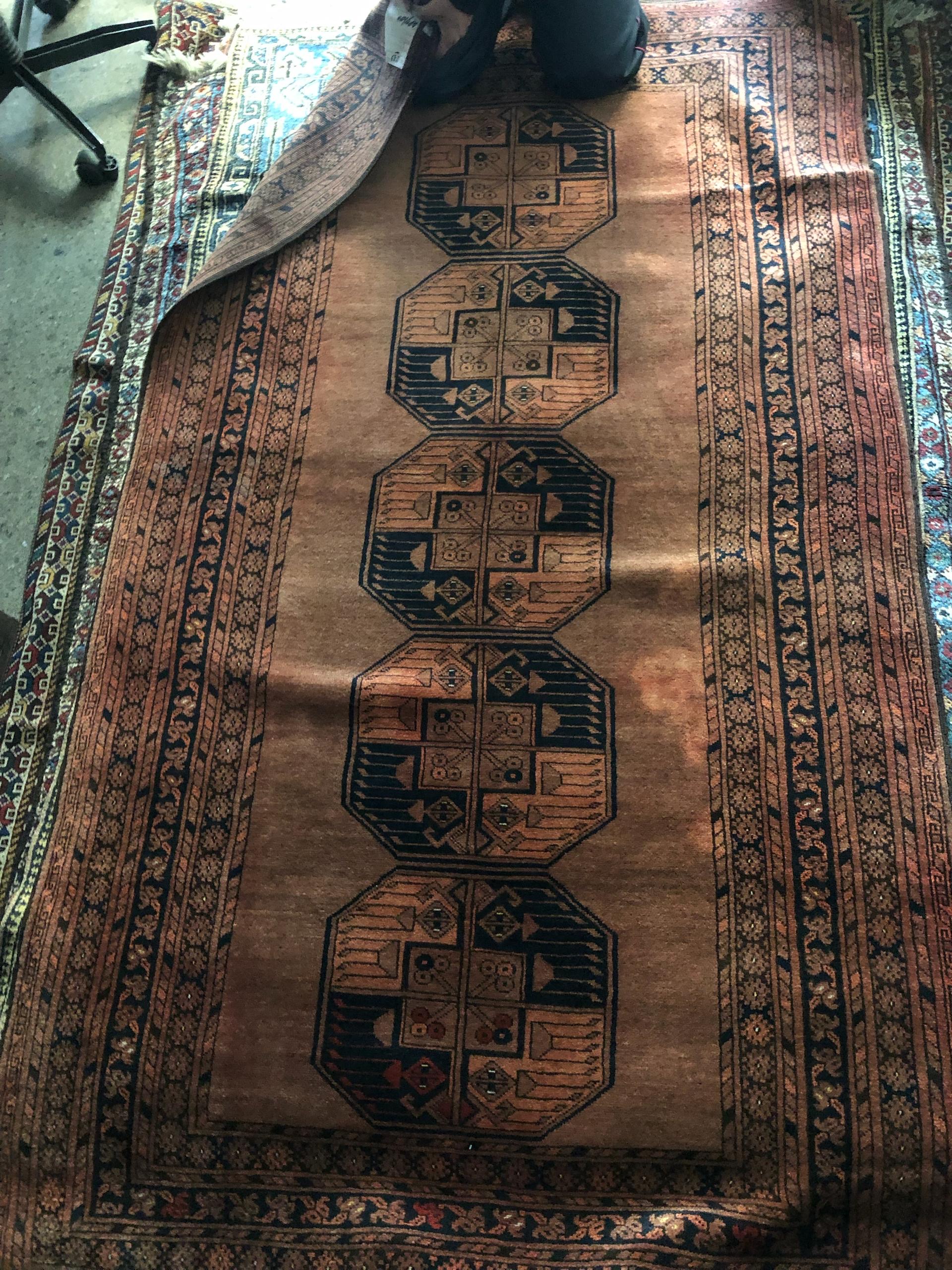
The color palette of this 120-year-old Afghan rug is earthy, warm, and deeply saturated, characteristic of the rich dyeing traditions of the Turkmen tribes.
- Primary Field: The dominant color is a warm camel tan, golden ochre, or soft rust-red, serving as a glowing, radiant background.
- Motifs: The repeating geometric medallions are woven in a deep, contrasting indigo blue and charcoal black, creating a bold, rhythmic visual beat.
- Accents: Inside the medallions and borders, the weaver has used small, jewel-like accents of ivory cream, brick red, and mustard yellow.
- Borders: The main border features a dark navy blue ground with repeating geometric motifs in camel, red, and ivory.
- Patina: A gentle abrash (horizontal color variation) is visible across the field, confirming the use of natural, hand-prepared organic dyes and adding immense depth and character.