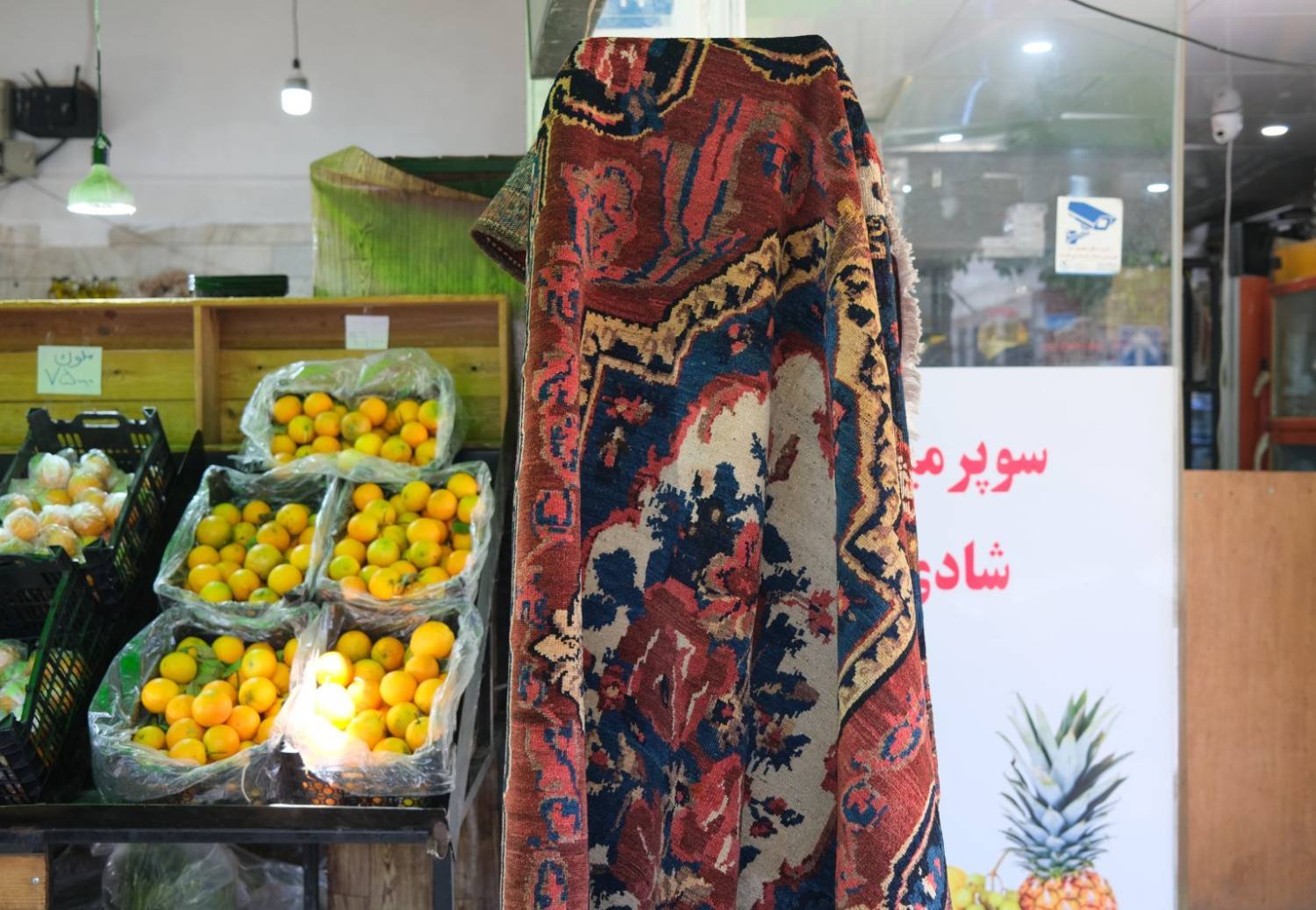
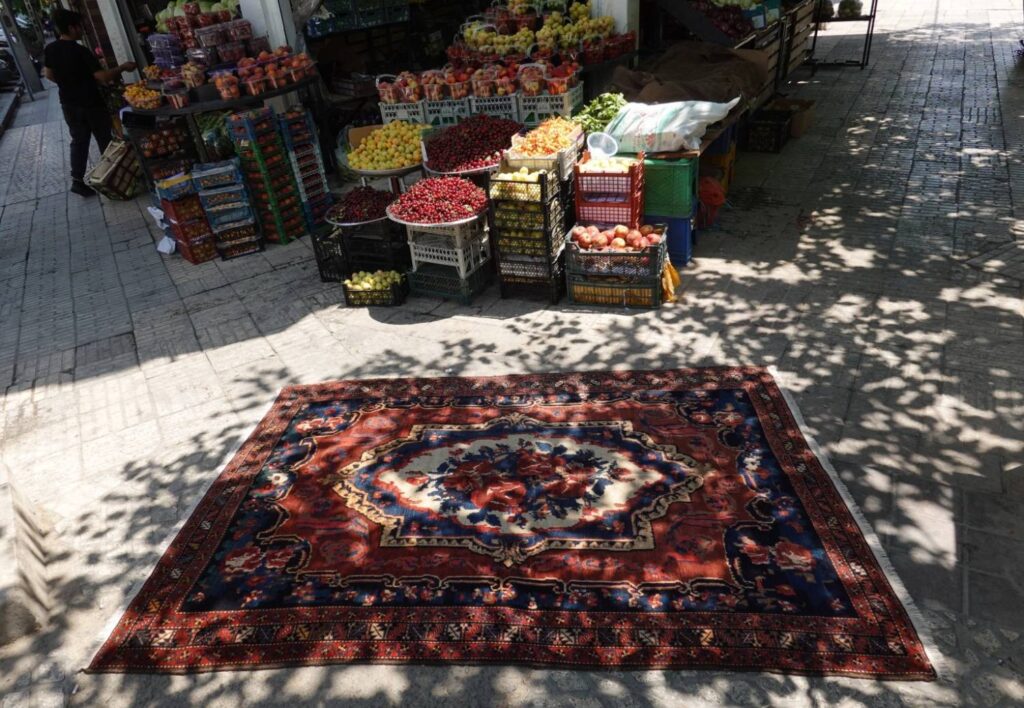
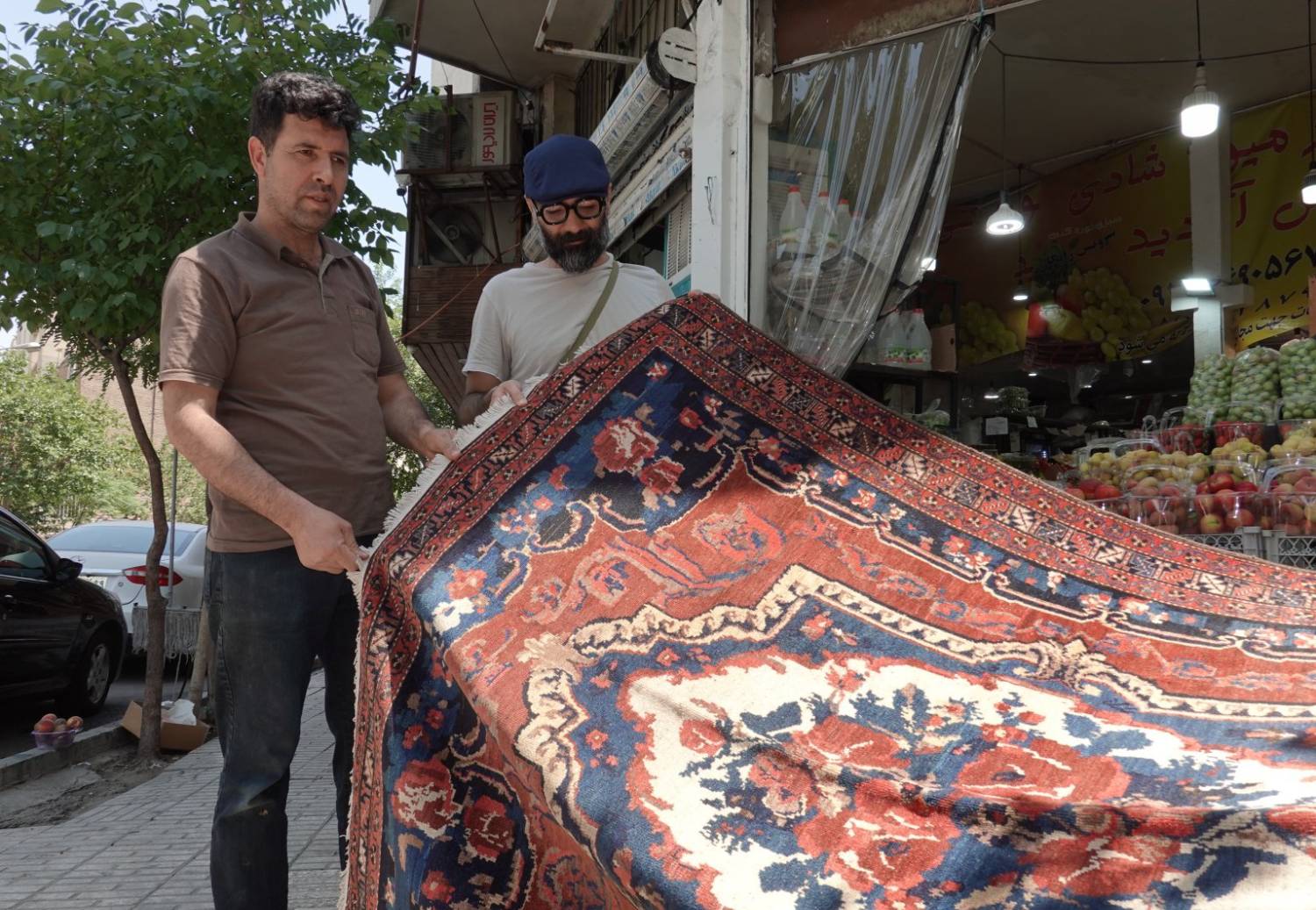
This is a hand-knotted Bakhtiyar (Bakhtiari) rug, originating from the Chahar Mahal and Bakhtiari province in the Zagros Mountains of western Iran. It is approximately 80 years old, dating to the mid-1940s, and measures 210 by 160 centimeters, which is roughly 6 feet 11 inches by 5 feet 3 inches. This size makes it a substantial area rug, ideal for a living room, a dining area, or a master bedroom. The rug is constructed entirely of hand-spun wool, which gives it a lustrous, durable texture that only improves with age. The image shows the rug being held by two men on a street, revealing a bold, dramatic design that is unmistakably Bakhtiyar in its origins.
The design layout of this Bakhtiyar rug is a classic “medallion and corner” composition, a style that has roots in the great Safavid court carpets of the 16th and 17th centuries. The field is dominated by a large, intricate central medallion that is diamond-shaped with lobed or stepped edges. This medallion extends vertically towards the top and bottom, creating a sense of grandeur and balance. At each of the four corners of the field, there are quarter-medallion spandrels that echo the design of the central piece, framing the field in a harmonious, symmetrical way. The space between the central medallion and the corner spandrels is filled with an all-over pattern of smaller floral motifs, leaves, and arabesques, creating a dense, textured appearance. The rug features a wide main border that is framed by several narrow guard borders, each with its own distinct, repeating pattern.
The motifs in this Bakhtiyar rug are a striking blend of geometric and floral elements, a signature of Bakhtiyar weaving. The central medallion contains a complex lattice of stepped diamonds, stars, and hook motifs, with a distinct central rosette that resembles a sunburst or a stylized flower. The corner spandrels feature quarter-medallions that mirror the central design, creating a sense of enclosure. Within the field, you can see stylized trees or “Tree of Life” motifs, which are represented by vertical stems with branching leaves and flowers. These trees are woven in ivory and green, standing out against the red field. The main border features a repeating “Herati” or “Running Dog” (S-hook) pattern. The Herati pattern consists of a small rosette surrounded by four curled leaves, symbolizing fish swimming in a pool. In this rug, the border pattern is highly stylized, with the leaves and rosettes woven in contrasting colors of blue, ivory, and red.
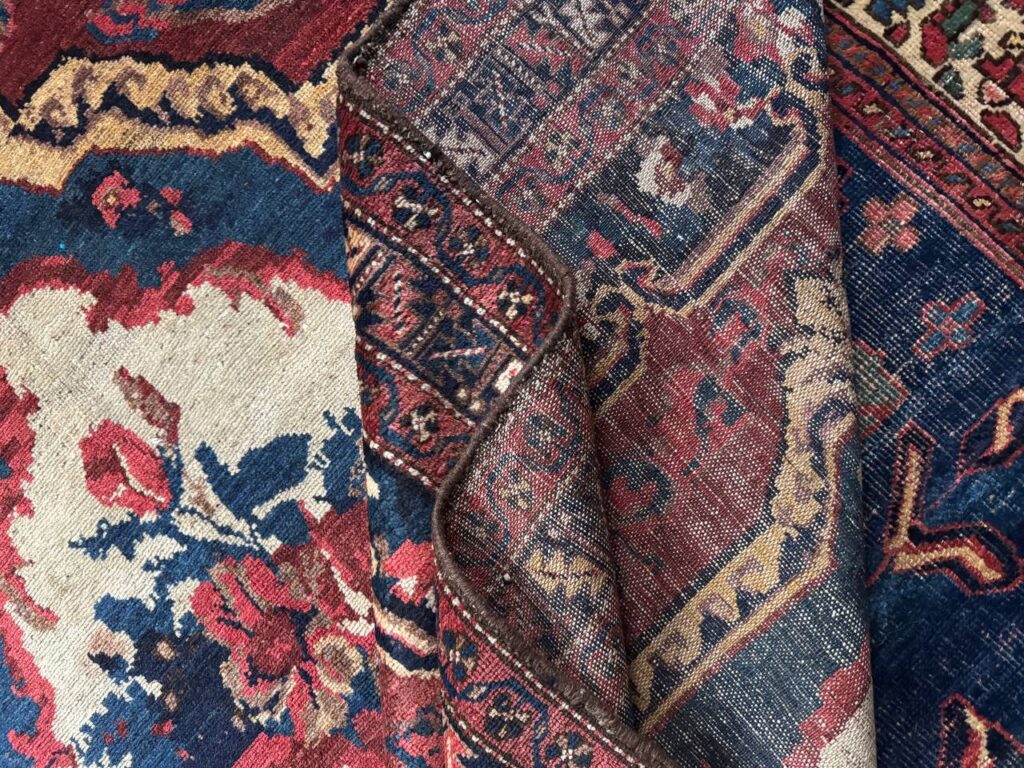
The rug’s field is dominated by a deep, indigo-blue ground that provides a dramatic contrast to the warm, rust-red and madder-orange tones of the primary motifs. At the heart of the design is a large, stepped-medallion or central floral pool, outlined in cream and red, containing stylized rosettes and hooked palmettes. The surrounding field is filled with scattered, tribal-style floral motifs, including blooming branches and abstract blossoms, arranged in a semi-symmetrical pattern typical of the Bakhtiyari weave. The borders feature a complex succession of geometric floral bands, anchored by a wide main border with a repeating herringbone or vine-scroll pattern in rust against a dark blue background, flanked by narrower guard stripes with smaller, repeating geometric dots and broken diamonds. The weave is tight, with distinct abrash (color variation) visible in the blue field, reflecting the hand-spun wool and natural dyes used in its creation.
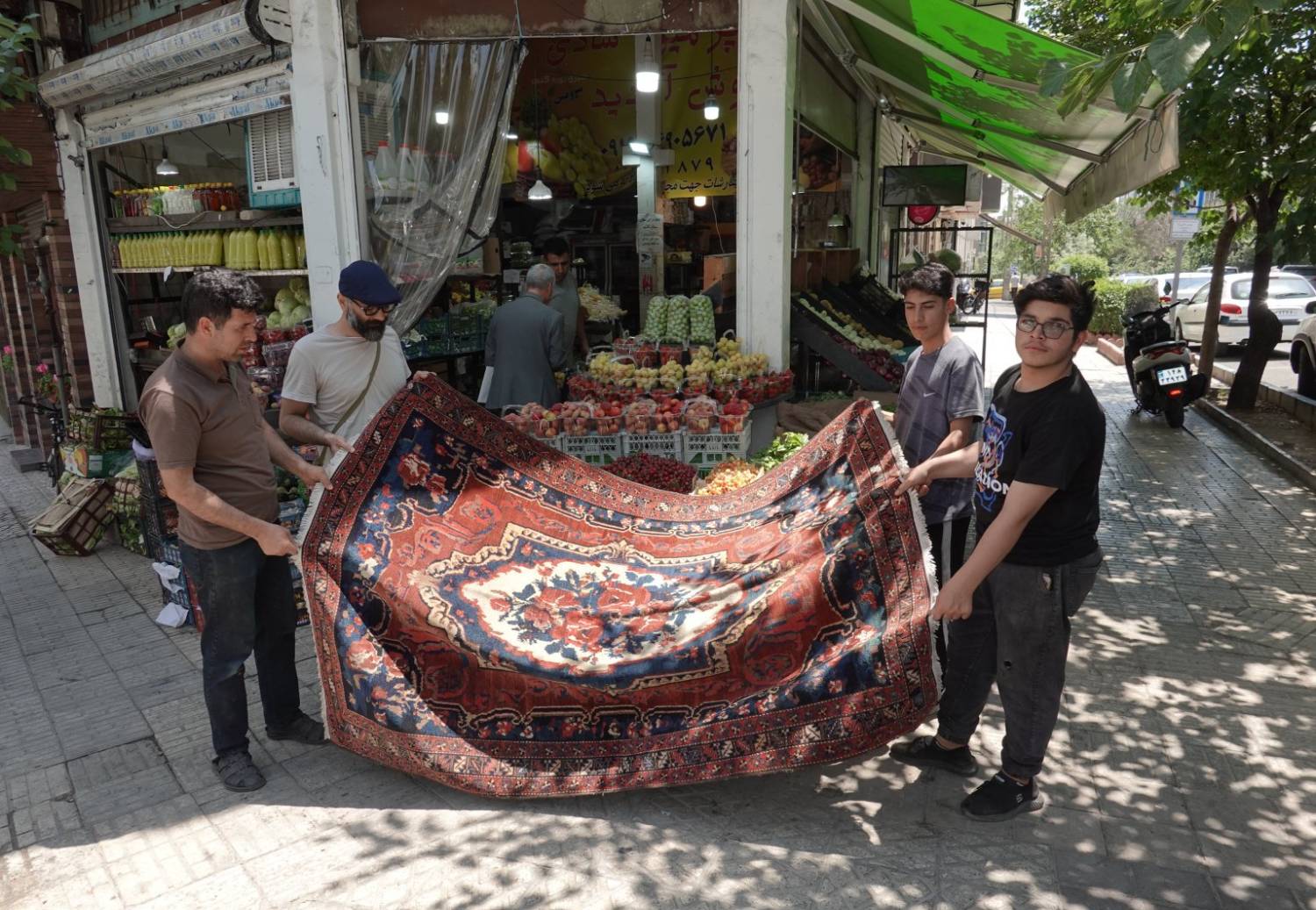
Color Palette: Deep indigo-blue field contrasted with rust-red, madder orange, cream, and hints of ivory.
Motif Details: Stylized floral rosettes, hooked palmettes, and blooming branches; borders include repeating herringbone/vine-scroll patterns and geometric guard stripes.
Visual Characteristics: High contrast between the dark field and lighter motifs, semi-symmetrical floral layout, and visible abrash (color striation) indicating age and natural dyes.
Construction: Hand-knotted wool on a cotton foundation, exhibiting the tighter weave and structural integrity typical of older Bakhtiyari pieces.