
This extraordinary antique Persian Farahan rug is a rare and highly collectible piece, estimated to be approximately 130 years old, dating back to the late 19th century (circa 1890s). Originating from the Farahan region in the Markazi Province of central Persia, these rugs are celebrated among connoisseurs for their exceptional weave quality, refined “Vase” or “Shah Abbasi” motifs, and the distinctive camel-toned grounds that distinguish them from other Persian styles. This hand-knotted masterpiece measures 210 centimeters in length by 135 centimeters in width (roughly 6’11” by 4’5″), making it an ideal runner or accent rug for a hallway, living room, or dining area. The rug is hand-knotted using high-quality wool on a cotton foundation, featuring a tight, dense knot count that speaks to the extraordinary craftsmanship of the late 19th century.
In terms of design and motifs, this Farahan rug features a magnificent, highly sophisticated “all-over” floral pattern that is a hallmark of the region’s finest weavings. The central field is set against a warm, aged camel or golden-beige ground, which serves as a luminous canvas for the intricate design. The entire field is densely populated with a complex, interlocking network of flowing vines, palmettes, rosettes, and stylized floral sprays, rendered primarily in deep indigo blue, soft madder red, and touches of ivory. The design is asymmetrical and organic, with no single dominating medallion; instead, the eye travels across a continuous, rhythmic landscape of botanical forms. At the upper end of the field, there is a distinct, upward-pointing architectural or “vase” motif, from which floral sprays emerge, a traditional Farahan signature. The motifs are drawn with remarkable precision and elegance, showing a delicate, almost calligraphic quality that is highly prized by collectors.
The border framing this intricate field is equally refined and beautifully proportioned. It consists of a wide main border set against a dark indigo or navy blue background, which provides a striking contrast to the light camel field. The main border features a continuous, meandering “herati” or scrolling vine pattern, populated with repeating, stylized rosettes, lotus flowers, and leaf motifs in camel, red, and cream. Flanking the main border are multiple narrow guard stripes, alternating between deep blue and camel, featuring small, repeating chain-link and diamond motifs. The corners are meticulously resolved, with the border patterns turning at perfect angles, demonstrating the weaver’s mastery. The outer edges are secure, and the rug features short, hand-tied fringes at the bottom edge, which have naturally aged to a soft, creamy yellow, showing the gentle wear of 130 years.
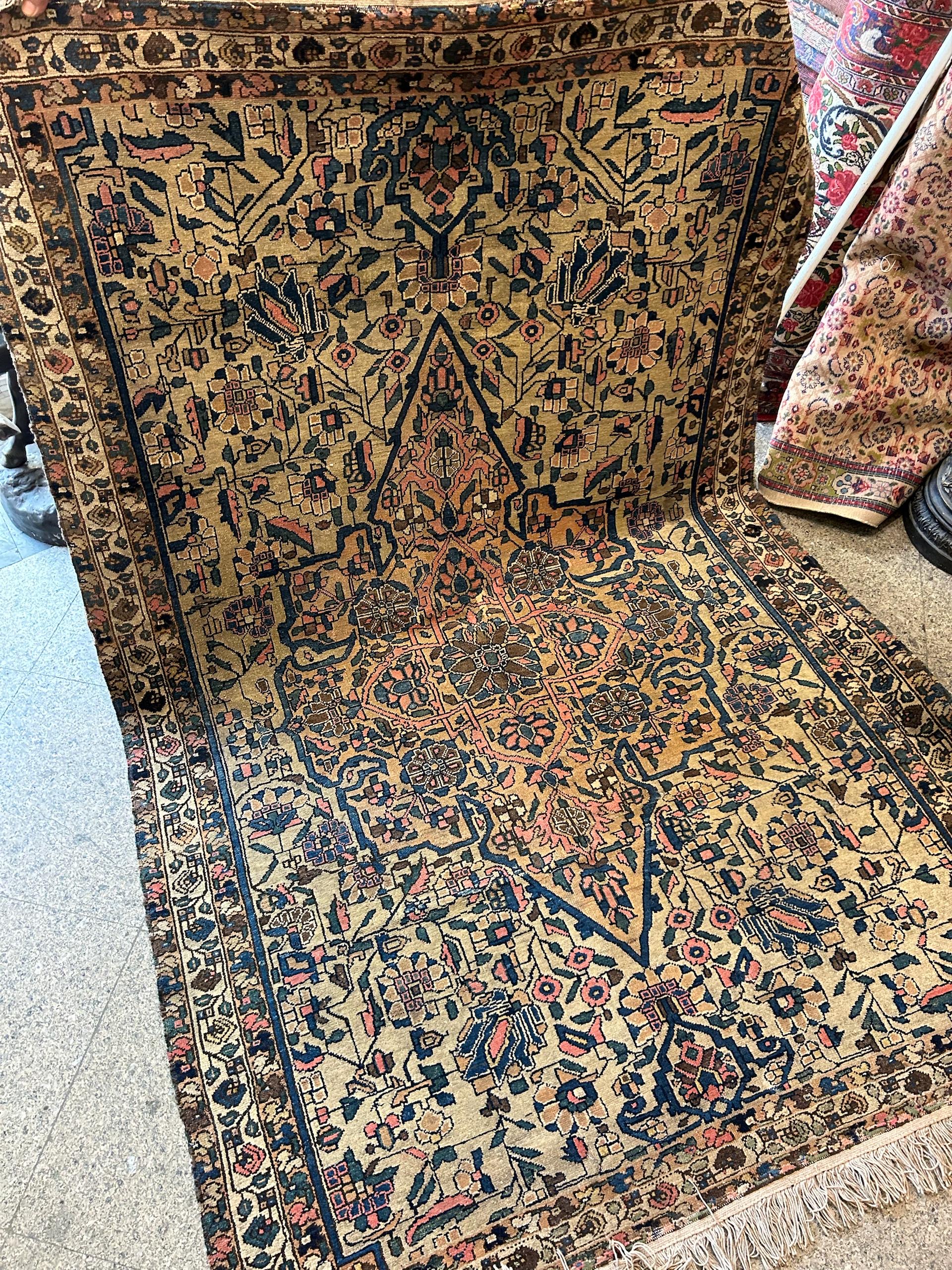
The color palette of this 130-year-old Farahan rug is one of its most distinguished features, characterized by a serene, earthy elegance. The dominant color is a warm, luminous camel or golden-beige that fills the entire central field. Contrasting against this is a deep, rich indigo blue used in the main border, the floral outlines, and the accent motifs. Secondary colors include a soft, aged madder red, ivory, and touches of soft pink and charcoal brown. The rug exhibits a beautiful, subtle “abrash” across the field, where the camel dye shifts slightly from row to row, creating a mottled, dimensional effect that only age and natural dyes can produce. In terms of condition, this is a true 130-year-old antique and shows the expected signs of its century-long life. The pile is low and worn, which is typical for rugs of this vintage, but the structural integrity remains solid, with no major holes or damage. The soft, silky texture of the aged wool, combined with the exceptional artistry of the floral design, makes this Farahan rug a rare, museum-quality piece that will bring unparalleled history, elegance, and craftsmanship to any interior.


