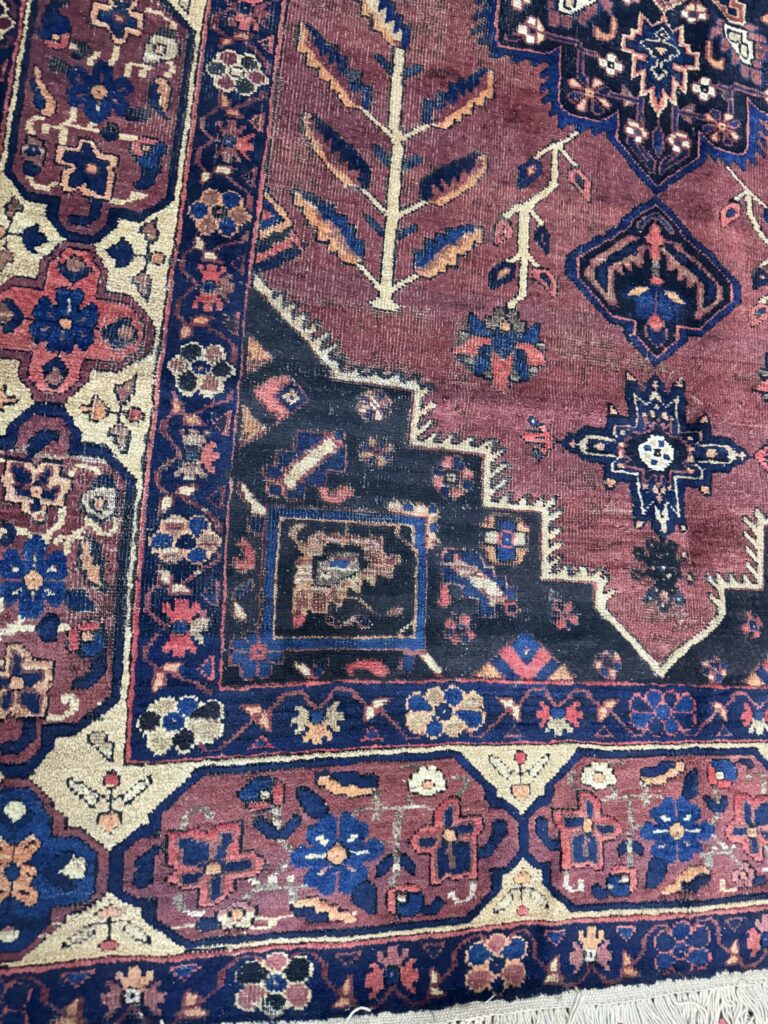
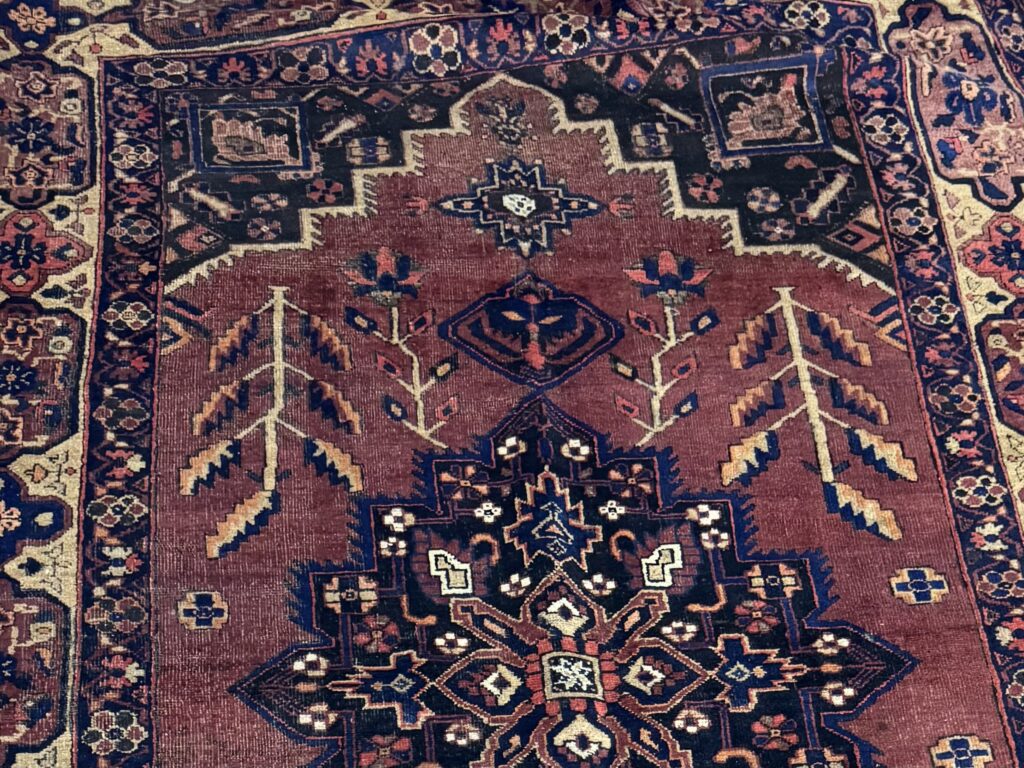
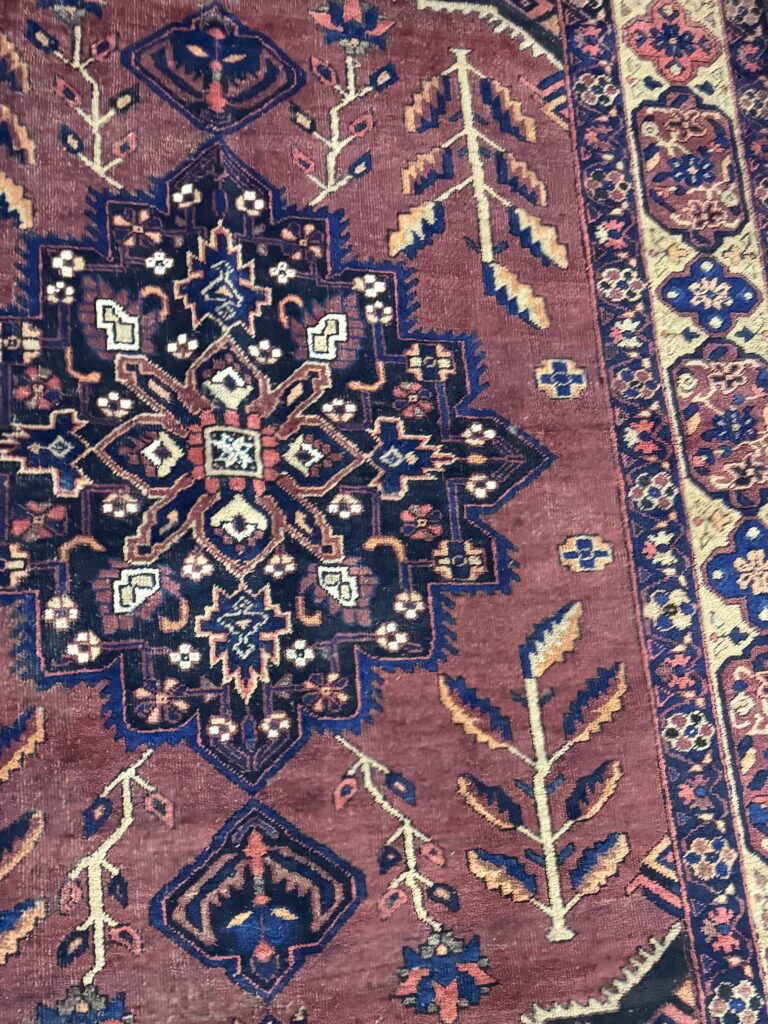
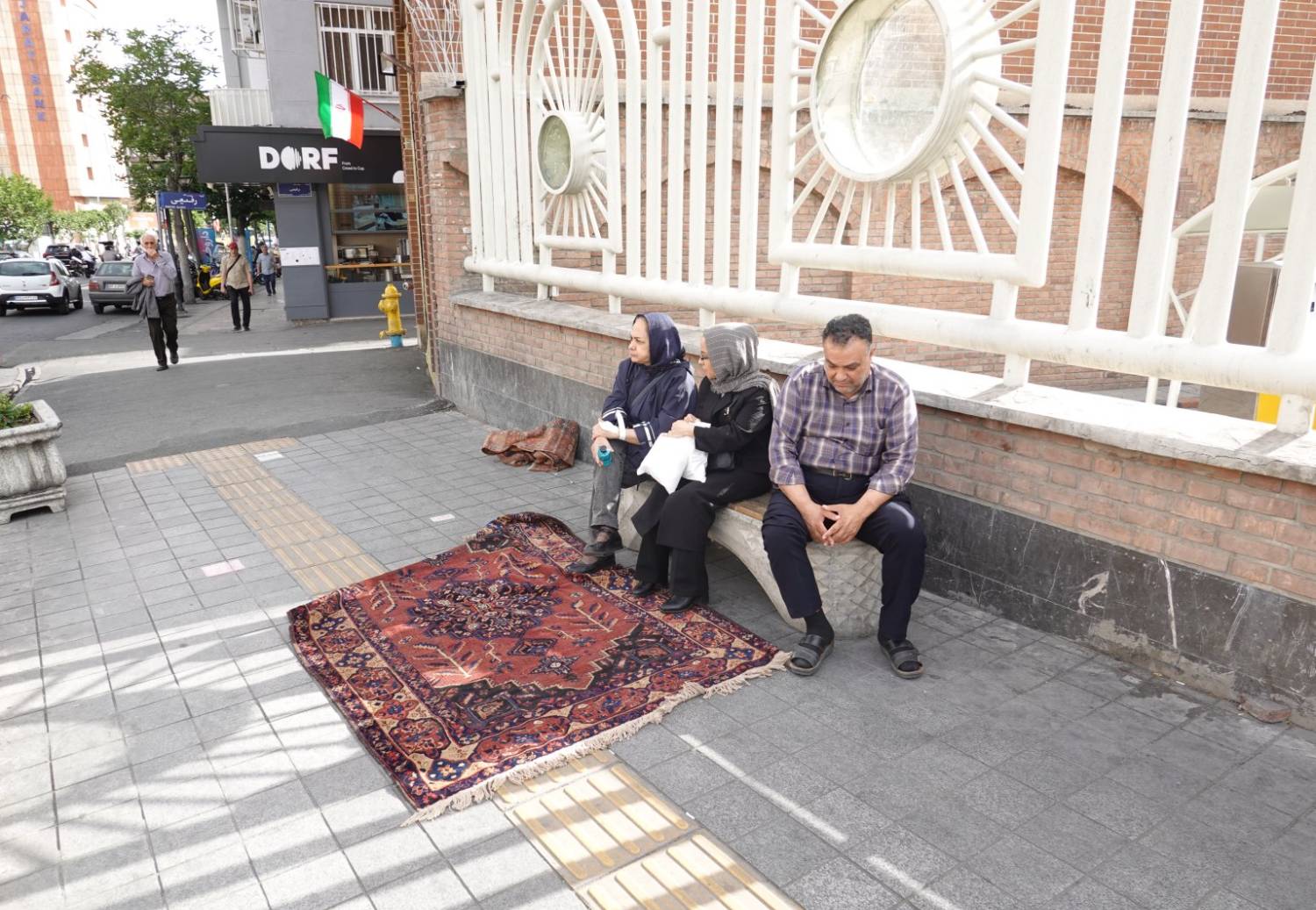
This is a hand-knotted Ferdows rug, originating from the Ferdows region in the Khorasan province of northeastern Iran. It is approximately 60 years old, dating to the early 1960s, and measures 245 by 148 centimeters, which is roughly 8 feet by 4 feet 10 inches. This size makes it a versatile area rug, suitable for a living room, dining area, or a long hallway. The rug is laid out on a tiled outdoor surface, and its colors appear vibrant and well-preserved despite its age. Ferdows rugs are historically significant because the region was a major center for rug weaving, and this piece exhibits the classic “medallion and corner” layout that defines the best of Khorasan weaving.
The design layout of this Ferdows rug is a classic “medallion and corner” composition, a style that has roots in the great Safavid court carpets of the 16th and 17th centuries. The field is dominated by a large, intricate central medallion that is diamond-shaped or lobed, extending vertically towards the top and bottom. This medallion contains a complex internal pattern of floral arabesques and geometric forms. At each of the four corners of the field, there are quarter-medallion spandrels that echo the design of the central piece, creating a sense of balance and harmony. The space between the central medallion and the corner spandrels is not empty; it is filled with an all-over pattern of smaller floral motifs, leaves, and branches, creating a dense, textured appearance. The entire field is enclosed by a wide, elaborate main border.
The motifs in this Ferdows rug are a blend of geometric and floral elements, typical of the Khorasan style. The central medallion features a complex lattice of stepped diamonds, stars, and hook motifs, with a distinct central rosette that resembles a sunburst. Within the field, you can see smaller “Tree of Life” or “Boteh” (paisley) shapes, which are stylized representations of a cypress tree or a leaf. These boteh motifs are scattered throughout the red field, pointing upwards and adding a sense of movement to the design. The main border features a repeating “Herati” pattern, which is one of the most famous patterns in Persian carpet weaving. The Herati pattern consists of a small rosette or flower surrounded by four curled leaves, resembling a fish swimming in a pool. In this rug, the Herati border is highly stylized, with the leaves and rosettes woven in contrasting colors of blue, ivory, and red.

The color palette of this Ferdows rug is rich, warm, and deeply saturated, reflecting the earthy tones of the Khorasan region. The primary field color is a deep, rust-red or madder red, which provides a warm, inviting background for the complex pattern. The central medallion and the corner spandrels are woven in a deep indigo blue and navy blue, creating a striking contrast against the red field. The motifs within the medallion and field are accented in ivory or cream, soft camel or golden brown, and touches of mustard yellow and dusty teal. The border features a lighter ground, likely cream or pale ivory, which frames the dark interior and draws the eye outward. The natural dyes used in this rug have aged gracefully, giving the colors a slightly muted, antique appearance that is highly desirable to collectors.
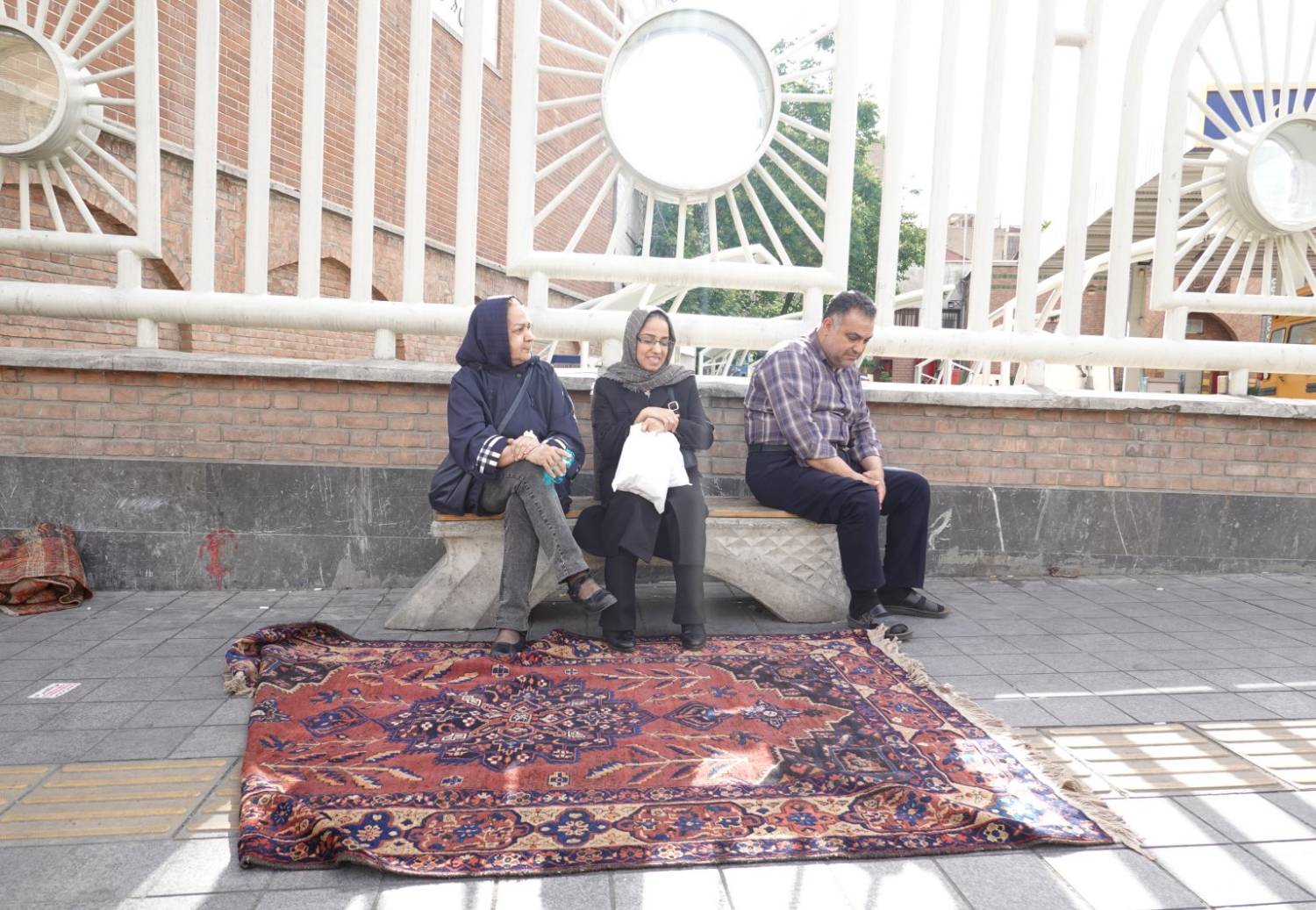
This 60-year-old Ferdows rug appears to be in very good vintage condition. The pile is low but even, showing a natural patina that only comes from decades of use. There are no visible holes, tears, or significant wear spots. The colors are well-preserved, with the red field showing a gentle, even abrash (color variation) that confirms the use of natural dyes. The fringes appear to be intact, though they are partially folded under the rug in the photo. The side edges (selvages) are secure and straight. For a buyer, this rug offers a robust, durable construction that can handle floor traffic while still providing the elegance of a classic Persian design.
Size: 245 x 148 cm (approximately 8′ x 4’10”), a versatile size for living rooms, dining areas, or hallways.
Design: Classic “medallion and corner” layout with a large, lobed central medallion and quarter-medallion spandrels.
Pattern: Features the famous Herati (fish) pattern in the main border, along with Tree of Life and Boteh (paisley) motifs in the field.
Colors: Rich rust-red field, deep indigo blue medallion, and ivory border accents, all achieved with natural dyes.
Symbolism: Contains layers of Persian cultural symbolism, including the sun (medallion), seasons (corners), and abundance (Herati border).
Condition: Very good vintage condition with even pile, secure edges, and intact fringes.
Value: A collector-worthy piece of mid-century Persian weaving that is both durable for floor use and elegant for wall display.