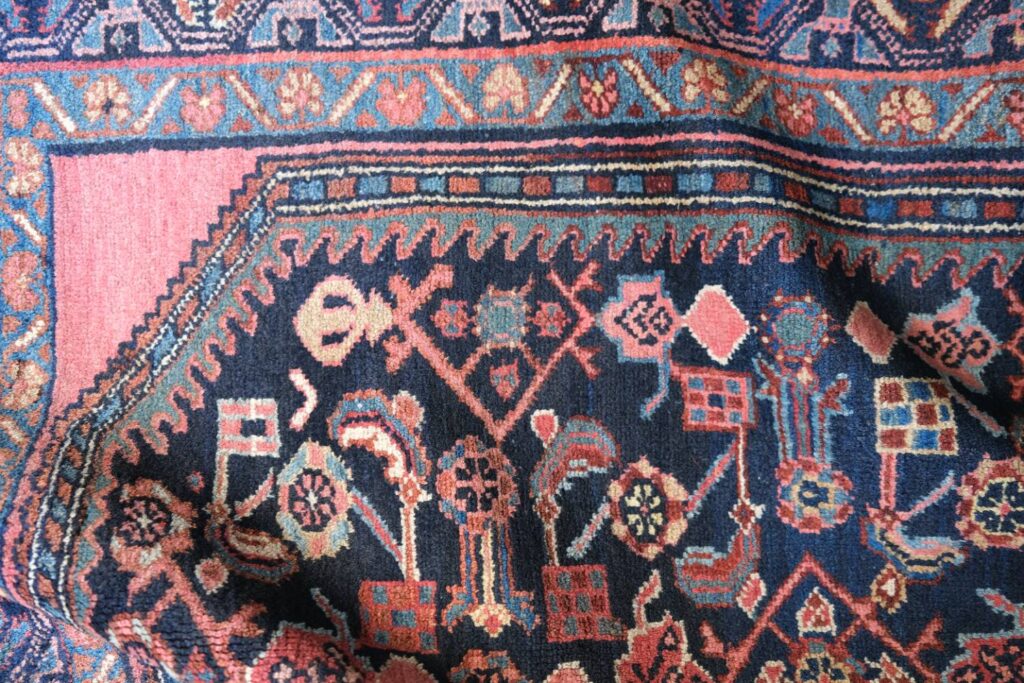
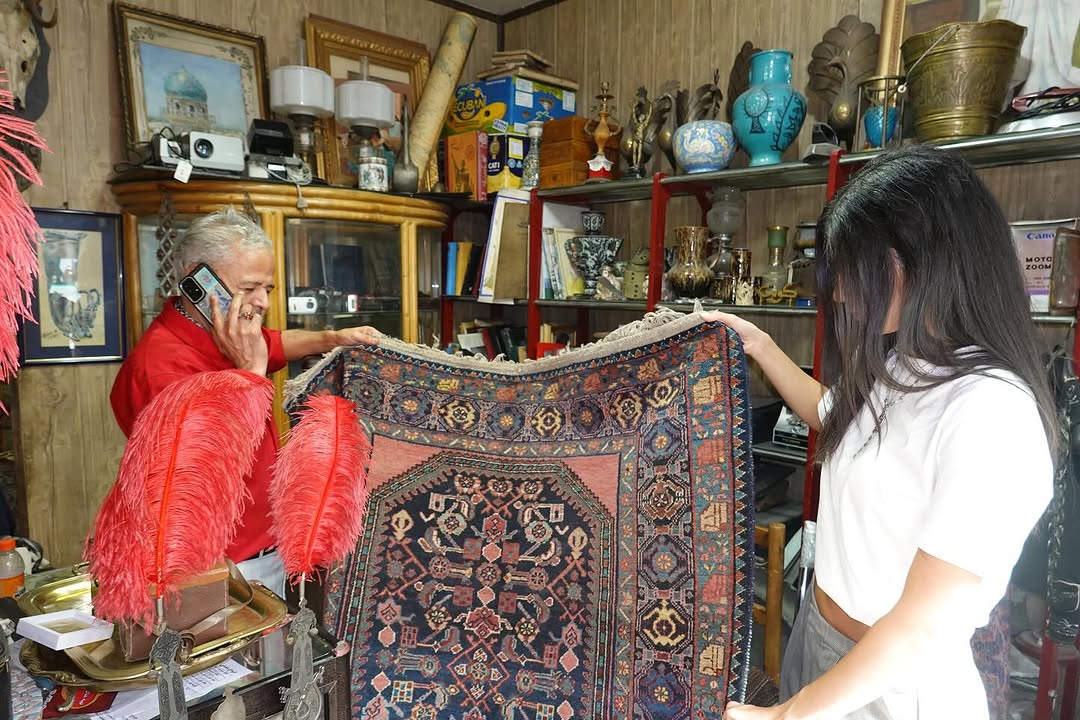
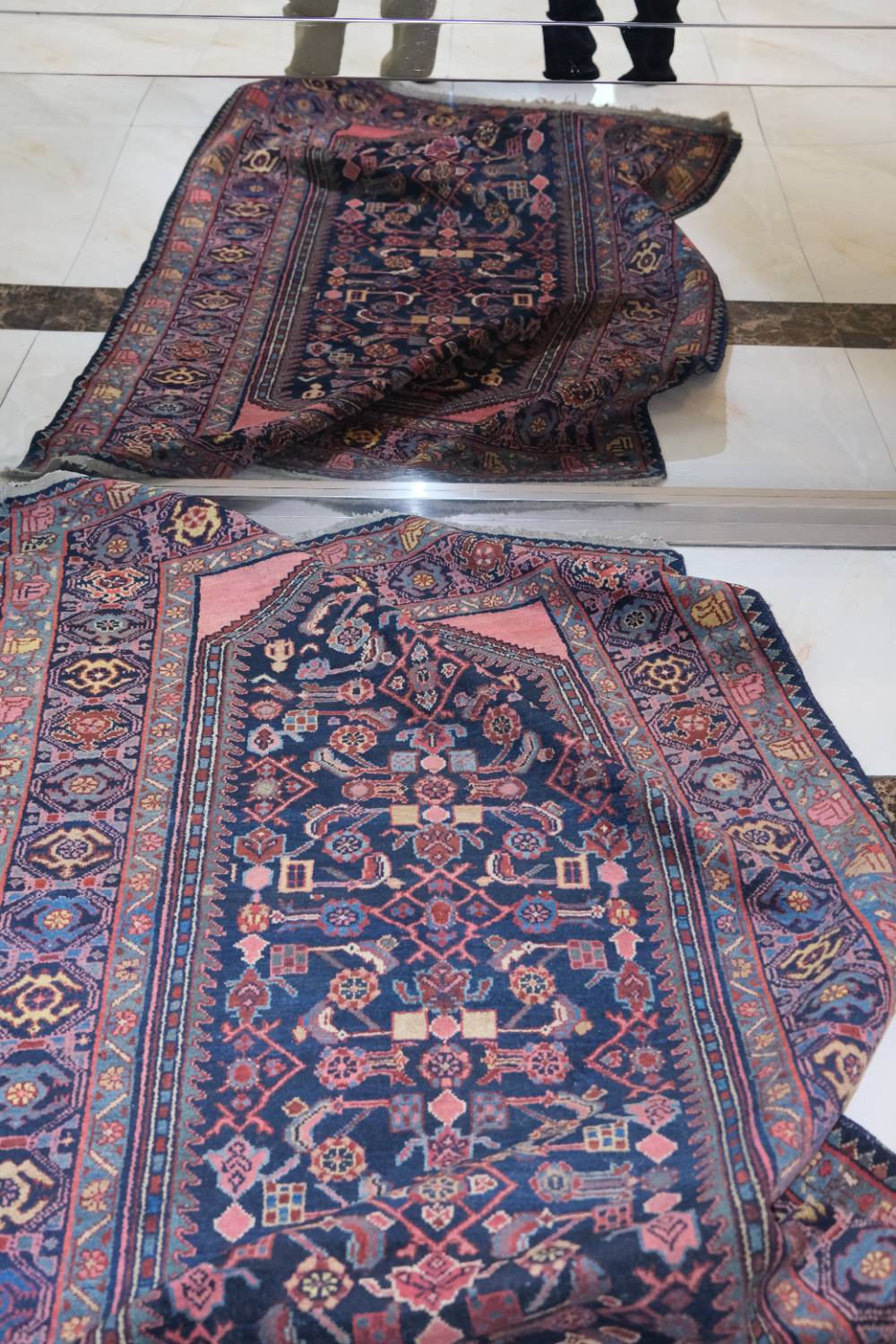
This is a hand-knotted Khamse rug, originating from the Khamse tribal confederation in the Fars province of southwestern Iran. The Khamse confederation historically consisted of five tribes: the Arab, Basseri, Ainalu, Baharlu, and Nafar. This rug is approximately 80 years old, dating to the mid-1940s, and measures 200 by 130 centimeters, which is roughly 6 feet 7 inches by 4 feet 3 inches. This size makes it an ideal area rug for a living room, a study, or a small dining area. The rug is shown partially folded and displayed under glass, which protects its texture and highlights the rich, saturated colors and intricate geometric patterns that are the hallmarks of Khamse tribal weaving.
The design layout of this Khamse rug is a classic “niche” or “prayer” layout, though it was likely woven for general decorative use rather than strictly for prayer. The field is divided into two distinct sections. The top section features a pink or salmon-colored arch, known as a mihrab, which creates a niche-like appearance. The main body of the field below this arch is a large, dark blue rectangle filled with a dense, all-over geometric pattern. The design is asymmetrical in its color placement, with the pink arch contrasting sharply against the dark blue field. The entire field is enclosed by a wide, complex border system consisting of a main border and multiple narrow guard borders. The corners of the field are shaped to accommodate the arch, a feature known as “stepped” or “latch-hook” corners, which is typical of Khamse weaving.
The motifs in this Khamse rug are predominantly geometric, with a strong emphasis on latch-hook(stepped) edges and cross-like forms. The dark blue field is filled with a repeating pattern of large, complex geometric shapes that resemble stylized flowers, stars, or even abstract birds. Many of these shapes feature a central “X” or cross, surrounded by stepped, tooth-like hooks. These are sometimes referred to as “elephant foot” or “fil pai” motifs, though in Khamse weaving, they are more accurately described as guls(tribal medallions) with heavy, protective hooks. Scattered throughout the field are smaller, secondary motifs, including small diamonds, S-hooks, and comb-like shapes. The main border features a repeating pattern of octagonal rosettes or stars, connected by geometric vines and leaves. The guard borders contain small, repeating chevron or zigzagpatterns, which act as a frame for the main design.
The color palette of this Khamse rug is deep, dramatic, and heavily reliant on natural dyes. The primary field color is a rich, dark indigo blue or navy blue, which provides a cool, absorbing background for the intricate geometric pattern. The motifs within the field are woven in contrasting shades of dusty pink, salmon, coral red, ivory, and pale yellow. The main border features a repeating pattern on a background of brick red or deep madder red, accented with the same blue, pink, and ivory tones found in the field. There is a noticeable abrash (horizontal color variation) across the blue field, which is a desirable feature that confirms the use of hand-spun wool and natural, organic dyes. The overall effect is a rug that feels both ancient and vibrant, with a harmonious balance of cool blues and warm pinks. The symbolism of this Khamse rug is deeply rooted in tribal folklore, protection, and the natural environment. The dark blue field represents the night sky, the infinite, and the protective cloak of the tribe. The pink arch at the top may represent the rising sun or the entrance to a tent, symbolizing a safe haven or a place of refuge. The latch-hook motifs (the stepped, tooth-like edges on the medallions) are the most powerful symbols in tribal weaving; they represent protective teeth or dragon claws, meant to ward off evil spirits and the evil eye. The “X” or cross shapes within the medallions are ancient symbols of the sun, light, and the four directions of the wind. The S-hook (often called the Kochak or Running Dog) represents the ram’s horns, symbolizing strength, leadership, and a wish for a large flock of sheep, which equates to wealth in a nomadic economy. The comb-like shapesscattered in the field represent the weaver’s own tools, symbolizing cleanliness, order, and the craft of weaving itself

Age: 80 years old (circa mid-1940s), antique vintage.
Size: 200 x 130 cm (6’7″ x 4’3″), ideal for living room, study, or small dining area.
Colors: Deep indigo blue field with dusty pink, coral red, ivory, and pale yellow accents.
Design: Unique “niche” or “prayer” layout with a pink arch at the top and a dark blue field below.
Pattern: All-over geometric field with latch-hook medallions, crosses, S-hooks, and comb motifs.
Border: Wide main border with octagonal rosettes and multiple guard borders with chevron patterns.
Symbolism: Protective latch-hook “teeth,” ram’s horns (S-hook), sun crosses, and weaver’s comb symbols.
Condition: Excellent antique condition with even, low pile, secure edges, and intact fringes.
Abrash: Natural color variation (abrash) confirms hand-spun wool and natural dyes.
Versatility: Suitable for floor use, wall display, or as a collector’s piece in a glass case.
Value: A highly collectible, authentic piece of mid-century Khamse tribal weaving with strong protective symbolism.